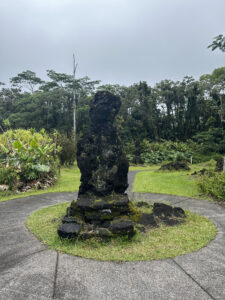
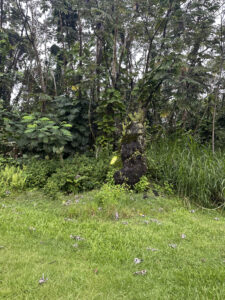
On Sunday, we got to see some lava trees! We learned that lava trees form because the large amount of water in trees makes the trees resist burning away for a longer period of time as the lava surrounds them. The lava trees we saw formed from the 1790 Kilauea eruption. They almost looked like statues! Mac told us about how the lava trees can tell us about the direction of the lava movement and about how the bark can be used to determine the age of the lava and when the eruption occurred.
We also visited Kalapana beach, which formed in 1990 due to Kilauea. The 50 foot deep lava flows buried the original beach, and the sand is now black, formed from the basaltic lava rock. The beach is a symbol of regrowth, and local communities are continuing work to restore the area.
Next, we went to Pohoiki, the island’s newest black sand beach. We got to learn about this location from Abby. Though it used to be a boat harbor, it is now covered with 5 year old lava flows from the 2018 eruption and sprinkled with warm springs heated by the eastern rift zone of Kilauea, some up to 98 degrees. I thought it was interesting that there are brine shrimp that live in the pools and about how one of the springs formed in the collapse of a lava tube. I didn’t get into any of the pools, but we saw lots of people swimming around when we visited. I stuck my hand in, and it was very warm.
— HG Kornberg