Today, I walked in the shadow of royalty.
Not literally, but Pololu Valley is one of the seven Valleys of the Kings, meaning it is where the legendary Hawaiian King Kamehameha spent much of his childhood. According to the valley’s caretakers, a prophecy foretold that Kamehameha would become king over all of Hawaii and unite the island under one chief. As a result, many of Hawaii’s chiefs, or ali’i, set out to kill all of the male children at the time of Kamehameha’s birth. However, supporters of the prophecy hid Kamehameha away in the area near Pololu; he sheltered there for the first five years of his life, until the local chiefs accepted the prophecy and allowed him to emerge from hiding. A tall, skinny pine tree marks the exact location of where the future king spent his early days. In addition, the floor of the valley contains Pu’u Ali’i, or the “Hill of the Chiefs” where many old Hawaiian leaders are buried.
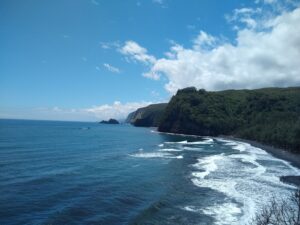
In addition to its deep cultural significance, Pololu Valley contains stunning natural beauty. As I made my way down the technically difficult trail to the valley floor, I got numerous glimpses of the Hawaiian coastline, including the other six valleys, whose greens and browns contrasted strikingly with the clear, blue ocean. Given the lush terrain, it should come as no surprise that Pololu and its neighbors are good agricultural locations. Centuries of native Hawaiians have practiced taro farming in the fertile, well-watered soil. Further adding to the scenic beauty were the sea stacks, which are like mini-mountains just off the Hawaiian coast. Sea stacks are created when waves begin to erode an outcropping of land, then wrap around the back of the little peninsula to completely cut it off from the main island. Erosive forces also influenced the sand of the valley, which is very fine because of heavy wind exposure at the bottom of Pololu.
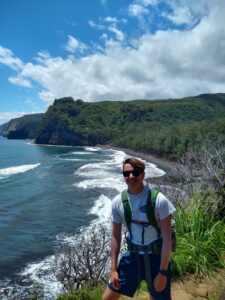
For me, however, the most enjoyable part of the experience was the thrill of racing down (and then up) the steep terrain of the valley. The guides at the beginning of the trail warned us of the dangers of falling or twisting an ankle, but I’m no stranger to technical, rocky climbs, and I loved the thrill of hopping from rock to rock, interrupted only by an occasional pause to talk to friends or snap a photo of the spectacular views.
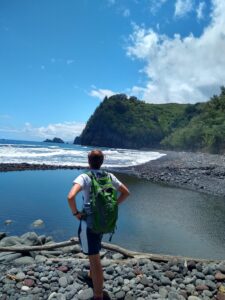
Unfortunately, the beautiful sights of Pololu Valley were slightly harder to focus on because of the atrocious smell. Our class had the misfortune to visit the location during a dry period in which what must have been thousands of tilapia were trapped in dwindling, brackish pools on the valley floor. Many of these poor fish had already met their demise, leaving the nasty stench of rotting fish as a parting gift. We saw their carcasses washed up on the rocks of the valley, as well as their surviving brethren crammed into the remaining patches of water. Hopefully a major rainstorm will bring some relief to the drying valley floor in the near future.
The hike was also a hot one. By the time I had made it back to the top of the valley, my arms were soaked in a solid layer of sweat, and our class’s water supply had swiftly run out. That made it all the more satisfying when we travelled into a nearby town—called Hawi, I believe—where I ate some delicious, handcrafted strawberry ice cream.
The adventure to Pololu Valley was only one part of an amazing day, but it was certainly the day’s most memorable experience. To see history, geology, and physical activity come together in such a beautiful way was truly remarkable.
– Aiden