After another early morning start, I began the day with a delicious Mac Malambri pancake for breakfast. With that fuel in my stomach, we set off for Hawaii Volcanoes National Park—our second day in a row visiting. Today, however, we went further from Kilauea’s summit to check out Chain of Craters Road, which runs along the volcano’s Southeast Rift Zone and—as the name would suggest—passes by quite a few craters. Though there were far too many for us to see them all, we did take time to observe a couple craters.
First was Puhimau, a large pit crater whose name literally means “forever smoking.” That proved to be true today, and a clear cloud of steam was visible on the far edge. Puhimau’s age is estimated between 200 and 600 years, and it is unique in that unlike many other craters, it has not been filled back in by new lava flows. Instead, a layer of talus, or debris that has fallen from the sides of Puhimau, litters the bottom. Like other pit craters, Puhimau formed very abruptly, giving it extremely steep sides. Unfortunately, this also means that such craters are at a constant risk of collapsing, so we were not allowed to actually go to the crater’s edge. It was still an impressive view, though.

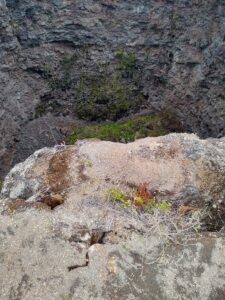
We also got to see Devil’s Throat, a “secret” crater that wasn’t formally marked. However, Devil’s Throat was clearly no longer as secret as it used to be, and we did see another group of tourists while we were there. This particular formation is sometimes considered the quintessential pit crater, and it offers a very clear view of both pahoehoe (smooth) and a’a’ (rough) lava flows in cross-section. Seen from the side, the pahoehoe flows were large, gray, and blocky, whereas the hardened a’a’ lava looked fine, red, and bumpy. We also learned that this particular crater was discovered by Thomas Jagger, the namesake of a now-closed geoscience museum at the Kilauea summit.
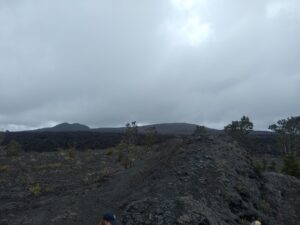
After our crater expeditions, we left the national park and made our way down the slope of Kilauea, towards the ocean. Along the way, we stopped for lunch and got a look at another impressive volcanic feature: Maunaulu. Maunaulu is a smaller mountain on the slopes of Kilauea that erupted between 1969 and 1974. Now, the downhill lava flows make a perfect spot for eating sandwiches and watching the Pacific.
Next, we finished our descent to sea level and completed another short hike to see the Pu’uloa Petroglyphs. Situated within an old pahoehoe lava flow, the site at Pu’uloa is a sacred place within Hawaiian culture. Here, generations of Hawaiians have left carved symbols in the flow; many of them were created by inserting the umbilical cords of newborns into the rock. In total, the site includes at least 23,000 petroglyph carvings. I was only able to see a tiny percentage of this amount, but they were certainly interesting. Many of the petroglyphs were circles and spirals, and some were even humanoid shapes. Along the way, I also found a cool new plant: the Showy Rattlebox, which has cylindrical seed pods that make a rattling noise when they dry out.
Our final stop for the day was the Holei Sea Arch, an arch of rock created by the erosive force of the Pacific Ocean. This location was a particularly special visit because of the fact that it won’t be around forever; the sea arch is unstable and could collapse at any moment. Thus, we had to stay far away from the arch itself and could only view Holei from a distance. After taking a few photos there, we headed back to the beach house for some kayaking and snorkeling before dinner.
-Aiden