Summary
We had a great time visiting Kaden's house and visiting one of Hawaii's black sand beaches!
Yesterday was our first day exploring the island!
In the morning, we had the opportunity to visit Kaden’s house around Kona. We got to see what it’s like to grow coffee, and I loved getting to see all the cool plants (like some avocado trees) there!
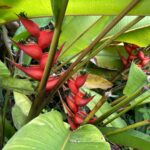

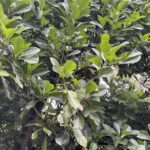
The coffee plant doesn’t look like I was expecting it to; the plant is very leafy, and the seeds turn colored. Most coffee farmers farm coffee as a side-gig because you need to have a lot of coffee to make good money off of it. To harvest the coffee from the plants, you take the seeds that hold the beans off and store them as “parchment” until there is enough to take to the processor. It sounds like a lot of coffee farmland in Hawaii is being bought by large-scale producers; I hope that Hawaiians are still able to have this type of farming in the future.

We also took a visit to Punalu’u beach, one of Hawaii’s black sand beaches. Punalu’u’s sand is made of basalt from lava from Mauna Loa and Kilauea. Upon cooling in the ocean, the lava exploded and broke into tiny pieces. The sand is thousands of years old.
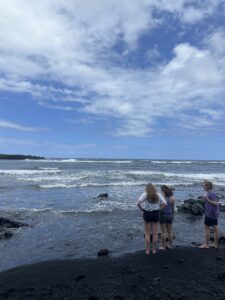
The beach is home to many sea turtles, and we got to see several while we were there! My favorite part of our visit here was probably when we got to see a turtle be rescued from some fishing line in its mouth and watch it swim back out to sea afterward.
While there, we were also on a mission to determine how many grains of sand were on the beach. We measured the length and width of the beach using our pace, estimated the depth, and calculated the volume of the sand in meters cubed. Assuming each grain of sand is 1 mm cubed, we were able to calculate an estimate of how many grains of sand there were. Each of us got a number between a trillion and 16 trillion. That’s a lot of sand!
What a fun day!
— HG Kornberg