By Mac Malambri
I will start where I ended yesterday’s post. After departing DEN, we encountered strong turbulence over the Rocky Mountains. I thought it was really fun; most people thought it was a good time to scream. Traversing the rest of the Continent was so cool. I learned a lot just from that. For example, the Rockies are sort of like the Appalachians in that they will have tall mountains followed by long valleys. There are usually at least forest service roads connecting those valleys to civilization. The Sierra Navadas are truly untamed wilderness with insurmountable peaks as far as the eye can see and no signs of civilization at all. You do not realize how vast the Pacific is until you travel over it. From 30,000 ft, it just looks like an empty, light blue surface with nothing: no signs of life or land or anything but water.
We landed by traveling around the front of the main island to the back of it. That gave us an awesome view of the beautiful island. We landed in Kona which is such a cool airport. It is open air and really fits the city. We spent that night in the Holiday Inn Express which was actually really nice. A group of nine of us got dinner that night at a restaurant in town. The fish was pretty good, but the view was better.
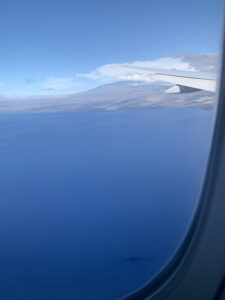
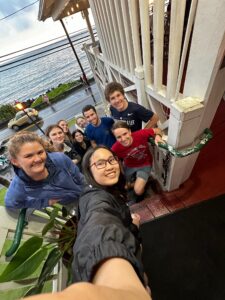
The next morning—which is the day this post is about—we awoke and got an early breakfast. A group of us went for a walk around Kona. The community was asleep. Kona is a really cool town. It reminds me of a nicer version of Jaco. It has many restaurants and hotels that like a narrow strip along the beach. After breakfast, we left Kona for Kaden’s neighborhood. Kaden Buss is one of the guys on my trip who happens to be from South Kona. His family has a farm. First, we visited his nearby neighbor with a larger farm. His neighbor told us about how much of Hawaii was given away in a 1940’s era homesteading scheme. He grows coffee and macadamia nuts but is gradually converting all the macadamia nuts to coffee, because the macadamia nut market is really bad right now. He moved to Hawaii from Florida. He said life without air conditioning or running water is different, but he is glad he made the move. We then traveled two minutes to Kaden’s home where his move graciously welcomed us with fresh fruit, banana bread, and Hawaiian soda. Kaden showed us around the farm and explained the process of growing coffee and tea.
We then departed for Punalu’u, home of a black sand beach. Black sand beaches result from the weathering of basalts—black, igneous rocks that form from higher temperature lava that has a lower silica content. Besalts are the predominant mineral on Hawaii, hence the predominance of black sand beaches on Hawaii. Black sand beaches are really different from the white sand beaches we have back home. The sand has much larger and courser grains than our sand back home. It feels soft in your hands. It also was really hot to touch on a cloudy day, so I can’t imagine what it is like on sunny day. As an exercise, we estimated that there are about 9 trillion grains of sand on the quarter mile stretch of beach we were on.
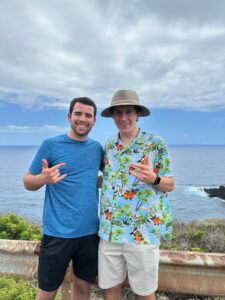
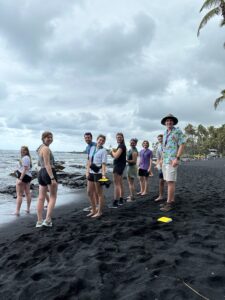
Next, we went to the footprints trail. In the 1790s, Mauna Loa erupted so quickly that the people foraging there could not escape. They were covered by the approaching lava and their footprints have been preserved. It was incredible how desolate the lava field was. It was mostly a’a lava, lava that flowed at a lower temperature. The whole scene reminded me of the planet where Anakin Skywalker was burnt alive in Star Wars Episode III. The hike was still cool, though.
Finally, we made the last drive to our rental in Hilo. We have a couple houses, next to each other, across from a beach. We finished the evening with Taco Tuesday and watching Mauna.
