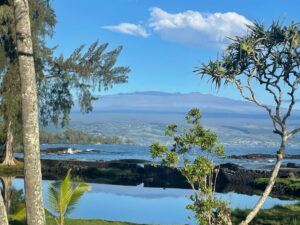
I woke up this morning to a pleasant surprise: the sky was clearer than usual, making for a pretty beautiful sunrise. After spending some time on the beach and grabbing breakfast, I set out to get some pictures of Mauna Kea, whose summit was completely visible without any clouds to block it. Walking down the shoreline, I got to see the volcano from a few different angles; I ended up wandering through some weeds, but I ultimately made my way back to the beach house.
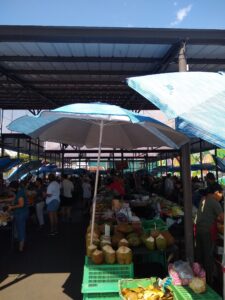
For the rest of the morning, we ventured into downtown Hilo for the city’s huge Saturday farmers’ market. The farmers’ market was a vibrant place, with local musicians playing in the streets and rows upon rows of vendors. The oceanside market had everything, from fruits and vegetables to arts and crafts. I tried passionfruit juice—or lilikoi juice, in Hawaiian—and also bought some souvenirs for friends back home. After checking out the vendors, I grabbed lunch at L&L Hawaiian Barbecue, a restaurant suggested by a very wise local (Kaden Buss), and ate with the rest of the class at Liliuokalani Park. A Japanese garden in the middle of Hilo, Liluokalani had some cool Asian architecture and an abundance of endangered Nene geese.
After lunch, we spent the afternoon driving up the Saddle Road, which runs between Mauna Kea and Mauna Loa. At first, it looked like the experience was going to be a dreary one, and heavy rain plagued most of our drive. However, the foul weather cleared away just as we reached our destination: Pu’u Huluhulu, or the “hairy hill.” The hairy hill is a kipuka, or a hill completely surrounded by lava flows. As a result, kipukas like Pu’u Huluhulu are essentially ecological “islands” that protect native species from foreign hazards. We had to be sure to wipe our shoes before entering the site in order to prevent the spread of invasive plants and diseases. The hairy hill is also a sacred location to native Hawaiians; it is seen as a place where the earth meets the sky, and we saw a statue of a Hawaiian sky god at the hill’s summit. The views from Pu’u Huluhulu were spectacular, and I could see three volcanoes (Mauna Loa, Mauna Kea, and Hualalai) from a single point.
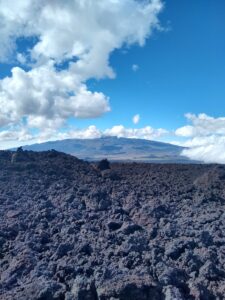
Then, on a whim, we decided to try driving up the Mauna Loa Observatory Road, parts of which were covered by a 2022 lava flow. Professor Knapp thought that the road would be completely closed, but we were actually able to make it all the way up to where the lava had covered the road. This allowed us the chance to walk over relatively fresh (two years old) a’a’ lava. It was sharp! When I took a wrong step, I fell and earned some big scratches on my leg. We also got an even better view of the Mauna Kea summit. Since the region where we were is often rainy, I felt very blessed to be able to see such spectacular sights without much interference from the weather.
-Aiden