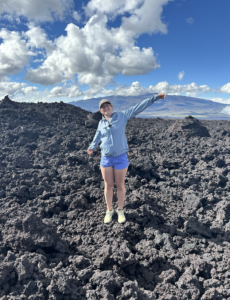
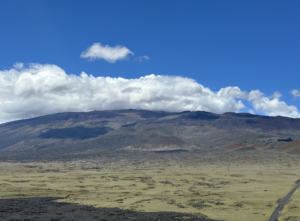
Yesterday, we ventured up the saddle road from Hilo toward the island’s center to visit a hairy hill and get a closer look at Mona Kea. The weather was looking questionable on our drive up, and we feared that we would be unable to see the beautiful view from this hairy hill right off the saddle road at the base of Mona Kea. This hill is called a Kipuka. It is a hill in the middle of a black lava desert, whose lush forest starkly contrasts with its barren landscape. Its name is Pu’u Huluhulu, which means hairy hill, which refers to the vegetation still growing from all sides of it. The hill was formed because it became a cinder cone resulting from explosive eruptions of Mauna Kea. Later, when Mauna Loa erupted, the hill escaped the flow and maintained its greenery. For this reason, this place is sacred to native Hawaiians, and as we got out of our vans, we reminded ourselves to be respectful of those who may be in worship or prayer. By some miracle, the dense rain clouds did not follow us to the hill, and we began our small hike in sunny conditions. Once we reached the top, we were in awe of the view’s expansiveness, as we could see three volcanos: Mauna Loa, Mauna Kea, and Kawaihae. Going further up the path, we saw a sacred sculpture of what we believe is the Hawaiian air God.
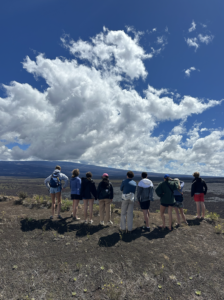
Still feeling adventurous, we sought to find the fresh lava that erupted from Mauna Loa in 2022. We had no idea if the observatory road was open, but we took our chances and went up it anyway. Suspecting the flow was at about 9000 ft, we kept climbing up, hoping the road would remain open. We were in luck! Just after 9000 feet, we saw the road overtaken by the 2022 flow, and we got out of the van to explore the view. We noticed the rock was much sharper than other flows we had walked over. The view was fantastic, and it was a unique experience to walk on such a young lava flow, as it was the closest we could get to real lava.